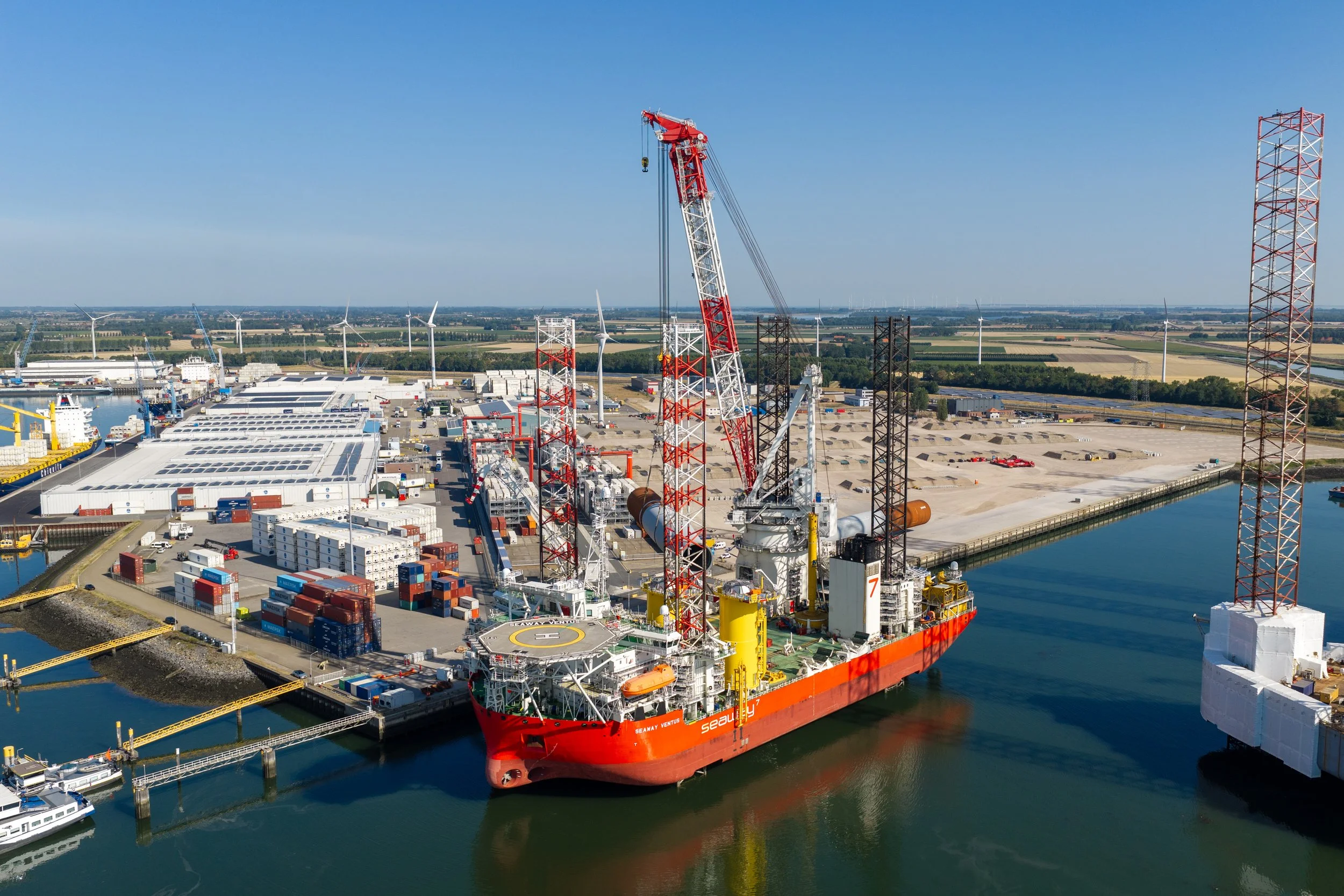
Seaway Ventus loading the last monopiles for the East Anglia 3 Project
Flying a drone in the Port of Rotterdam, Amsterdam or North Sea Port takes more than a pilot and a drone. A drone shot of a vessel leaving the quay looks effortless, but behind it sits a stack of permissions, checks and arrangements that the viewer never sees. A professional drone flight in a Dutch port touches at least five layers: the operator, the airspace, the port and the site, safety on location, and privacy.
If you plan a shoot in one of these ports, knowing these layers helps you brief your operator, set a realistic timeline and avoid surprises on the day. This guide walks through each of them from the client's side.
In short: who arranges what
Operational authorisation: issued by the ILT, held by the operator.
Airspace (CTR): coordinated with air traffic control where needed, by the operator.
Flight registration in the port: through the port portal for Specific Category operators, by the operator.
Terminal or site access: permission from the site owner, arranged by client and operator together.
ISPS security: through the terminal's security team, registration by client and crew.
Safety on site: requirements from the site's HSE department, met by the operator.
Privacy (GDPR): agreed between client and operator.
1. Which drone operator you need: Open vs Specific Category
European drone rules split flights into categories based on risk. The Open Category covers low-risk flying with clear limits on height, distance from people and location. Most consumer drones and hobby pilots fly here.
Port work almost never fits those limits. Flying near cranes, vessels, workers and infrastructure, often inside controlled airspace, puts a flight in the Specific Category. To fly there, an operator needs an operational authorisation from the ILT, the Dutch Human Environment and Transport Inspectorate. The authorisation is based on a risk assessment and an operations manual, and the ILT audits operators against it.
If you are looking for a "drone permit" for port work, this operational authorisation is what you need.
For you as a client, this is the first question to ask. An operator without a Specific Category authorisation cannot legally take on most port jobs, however good their footage looks. Ask for the authorisation number and check that it covers the type of flight you need.
2. Airspace: CTRs and restricted zones in Dutch ports
Large parts of the Dutch ports lie inside a control zone, or CTR, around an airport. The Port of Rotterdam sits largely in the Rotterdam CTR, and the Port of Amsterdam in the Schiphol CTR. Flights there fall under air traffic control rules.
From 26 November 2026, low drone flights in designated parts of the civil CTRs no longer need radio contact with air traffic control. That makes short-notice flights easier, but the ports remain Specific Category territory. We explain the change in detail in Drone rules around Rotterdam and Schiphol change on 26 November.
The CTR is not the only airspace question. Ports also contain or border other restricted zones, such as helicopter landing sites, military areas and critical infrastructure. North Sea Port is a good example, with restricted areas around the Borssele nuclear plant. Each zone has its own rules, so every location is checked before a flight is planned.
3. Permission in the port: flight registration, terminal and ISPS
Airspace permission does not give access to the ground below it. Three parties usually have a say.
Registering the flight in the port area. In the Port of Rotterdam, drone flights are registered through a dedicated portal that only Specific Category operators can access. The operator enters the location, flight altitude, drones and pilot. If there is no conflict with another mission in the same area, the request is approved straight away. For an experienced operator, this part is quick. Other ports have their own procedures, and your operator should know which one applies to your location.
The terminal or site owner. Taking off, landing or flying over a terminal, yard or quay needs the owner's permission. This is often the step that takes longest, because it runs through the site's own HSE and security departments. If you are the client and the site is yours, getting the right internal contact early saves days.
ISPS security. Most commercial terminals are secured under the ISPS Code. Crew and equipment need to be registered and cleared before they get through the gate. On some sites that means sending names and ID details well in advance.
4. Safety certificates and site requirements
Ports and shipyards are working industrial sites, and a film crew is treated like any other contractor. Expect the site to ask for:
Safety certificates. VCA is the common baseline in the Netherlands. Offshore work adds BOSIET or similar training.
A site induction before work starts, sometimes online in advance.
Personal protective equipment such as a helmet, safety shoes, high-visibility clothing and, near water, a life jacket.
A method statement or task risk analysis describing the flight, take-off and landing spots, and how the crew stays clear of operations.
On the drone side, a professional operator works with a flight plan, a ground risk assessment and, where needed, an observer who watches the airspace and the area around the drone. That observer is part of a safe operation, not an extra cost to cut.
5. Privacy (GDPR) and drone insurance
A drone over a busy terminal films people at work. Under the GDPR, that footage needs a lawful basis and careful handling. In practice this means informing staff on site, avoiding identifiable close-ups unless people have agreed, and agreeing who stores the raw footage and for how long. For some locations a privacy assessment is part of the permit process.
Insurance is the last layer. A professional operator carries third-party liability insurance that covers drone operations, and many sites ask to see the policy before the shoot. If your project has specific requirements, such as a minimum cover amount or the site named on the certificate, share them early.
How much lead time to plan for a drone shoot in a port
The airspace part is rarely what slows a project down, especially after the November rule change. Site permission, security clearance and internal approvals take longer. In our experience, two weeks is a comfortable lead time for a standard port shoot. Some terminals and offshore projects need more. Short-notice work is possible, but it depends on how quickly the site can respond.
An example from our own work: for a Hapag-Lloyd assignment at APM Terminals, we first had to submit risk assessments and arrange the required permits. On the day itself we carried out an LMRA, a last minute risk assessment, before we were allowed to start. The flight was the smallest part of the job. That is typical for terminals: the preparation sets the schedule, not the flying.
Maritime schedules also move. Vessels arrive late, weather closes in, a crane lift slips by a day. Build some flexibility into the shoot date and agree with your operator how a change is handled.
Before you contact an operator, it helps to have these ready:
The exact location, ideally with a pin on a map
The preferred date and how flexible it is
What you want to capture: a vessel movement, construction progress, an event, a corporate film
Who your contact is at the site or terminal
Any site rules you already know, such as required certificates or ISPS registration
Where the footage will be used, so privacy and licensing can be agreed upfront
Frequently asked questions
Do I need a permit to fly a drone in the Port of Rotterdam?
Yes. Most flights in the port need a Specific Category operator with an operational authorisation, plus flight registration and permission from the site owner. Airspace rules come on top of that.
How is a drone flight registered in the Port of Rotterdam?
Through a dedicated portal for Specific Category operators. The operator enters location, altitude, drones and pilot, and the flight is approved straight away if it does not conflict with another mission.
Can a hobby drone pilot film in a port?
In almost all cases, no. The Open Category, where hobby and consumer drones fly, does not cover flights near industrial sites, vessels and workers in controlled port airspace.
How far in advance should I book a drone operator for a port shoot?
Two weeks is a comfortable lead time for a standard shoot. Offshore projects and some terminals need more, mostly because of site access and security clearance.
Does the November 2026 CTR change mean drones can fly freely in the port?
No. Low flights in parts of the Rotterdam and Schiphol CTRs no longer need radio contact with air traffic control, but the ports remain Specific Category territory and all site permissions still apply.
What determines the price of a drone shoot in a port?
The location and its procedures, the number of flight locations, the length of the shoot, whether an observer is needed, and the footage and editing you want delivered. Send your location and date for a concrete quote.
Let us handle the layers
At Portside Media we work in these environments every week, from Maasvlakte to the North Sea Canal and North Sea Port. We hold a Specific Category operational authorisation (NLD-OAT-176/02G), know the port procedures and arrange the airspace, site permissions and safety paperwork, so your team can focus on the project itself.
See how we work on our drone operations page, read more about flying in controlled port airspace, or get in touch with your location and date.